Building Inspection under Thailand Building Control Act: 9 Safety Systems & Checklist for Licensed Engineers
Key Takeaway: Under Thailand Building Control Act B.E. 2522 and Ministerial Regulation B.E. 2548, high-rise buildings, extra-large buildings, factories, hotels, and assembly places must undergo mandatory engineering inspections. A 5-Year Major Inspection and annual audits are required to obtain the Building Inspection Certificate (Form R.1). Non-compliance carries legal penalties up to 3 months imprisonment and daily fines up to 10,000 THB.
1. Why is Annual Building Inspection Mandatory in Thailand?
Following major fire disasters in Thailand, the Department of Public Works and Town & Country Planning enacted strict regulations requiring 9 building categories to undergo systematic engineering safety evaluations. The purpose is to verify structural integrity, fire pump readiness, pressurization fan reliability, and life safety compliance.
2. 9 Categories of Buildings Subject to Mandatory Inspection
| Building Category | Legal Size / Criteria | Engineering Risk Level |
|---|---|---|
| 1. High-Rise Buildings | Height $\ge 23.00$ meters from ground to roof deck | Very High (Stairwell Pressurization & Fire Pumps required) |
| 2. Extra Large Buildings | Total floor area across all levels $\ge 10,000\text{ m}^2$ | Very High (High fire load & occupant capacity) |
| 3. Assembly Buildings | Area $\ge 1,000\text{ m}^2$ or occupant capacity $\ge 500$ people | High (Complex evacuation dynamics) |
| 4. Factories | Height $> 1$ story and total usable area $\ge 5,000\text{ m}^2$ | High (Chemicals, flammables & machinery) |
| 5. Entertainment Venues | Total area $\ge 200\text{ m}^2$ | High (Enclosed spaces, emergency lighting critical) |
| 6. Hotels | Total guest rooms $\ge 80$ rooms | Medium-High (Unfamiliar escape routes) |
| 7. Condominiums / Apartments | Total area $\ge 2,000\text{ m}^2$ | Medium (24/7 residential occupancy) |
| 8. Hospitals | Hospitals with overnight inpatient beds | Very High (Non-ambulatory patients) |
| 9. Billboards | Height $\ge 15\text{ m}$ or area $\ge 50\text{ m}^2$ on ground | Structural Risk (Wind load fatigue) |
3. 5-Year Major Inspection vs. Annual Inspection
| Comparison Parameter | Major Inspection (Every 5 Years) | Annual Inspection (Yearly) |
|---|---|---|
| Frequency | Every 5 Years | Annual (Years 1, 2, 3, 4 of 5-year cycle) |
| Engineering Scope | In-depth structural audit, Fire Load calculation, As-built drawings review, complete 9-system audit | Preventive maintenance check, functional alarm triggering tests |
| Documentation | Form R.1 Major Audit Report & Building Safety Management Plan | Annual Progress Audit Report for R.1 Certificate Renewal |
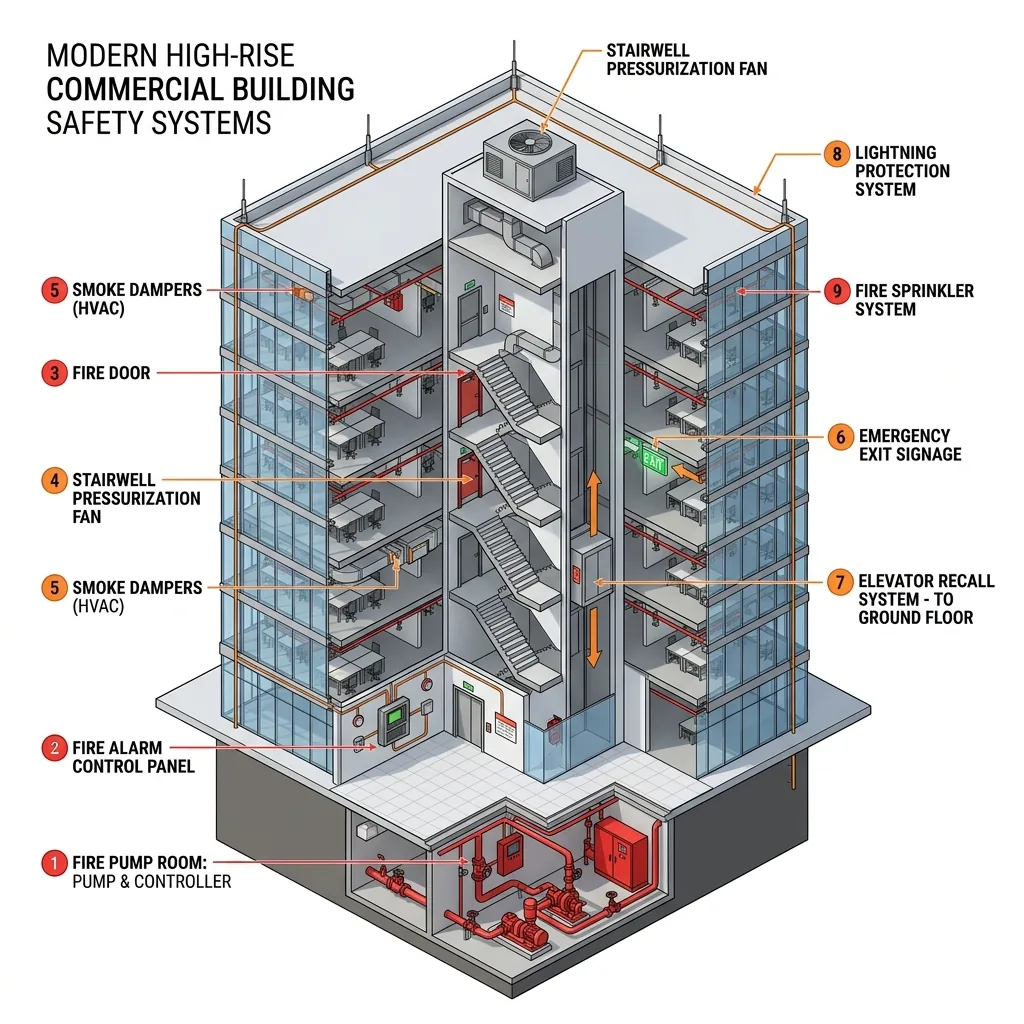
4. Summary of the 9 Building Safety Systems Checklist
- System 1: Structural Integrity (Columns, beams, steel fireproofing rating)
- System 2: Fire Protection Systems (Fire Pump NFPA 20 flow test, Sprinklers NFPA 13, Standpipe NFPA 14, Extinguishers NFPA 10)
- System 3: Fire Alarm System (FACP, Smoke/Heat Detectors, Notification bells NFPA 72)
- System 4: Stairwell Pressurization & Exits ($\Delta P \ge 25\text{ Pa}$ per NFPA 92, Fire doors NFPA 80, Exit signs NFPA 101)
- System 5: Smoke Control & Dampers (Fire/Smoke Dampers NFPA 90A, Exhaust fans)
- System 6: Electrical & Emergency Power (MDB Thermoscan, Generator ATS transfer within 10s)
- System 7: Sanitary & Fire Water Storage (NFPA 22 Fire water tank 30-60 min capacity)
- System 8: Elevator Safety & Fire Recall (ASME A17.1 Phase I Recall & Phase II firefighter control)
- System 9: Safety Management & Evacuation Drills (Evacuation plans & annual fire drill records)
💬 Consult New Type Engineering Inspectors
Get professional advice on building safety audits and standards compliance!
Comprehensive Building Safety Audit & Inspection Services
New Type Engineering Co., Ltd. (ISO 9001:2015 certified) provides professional building safety audits, engineering certifications, and system upgrades.