
The Psychology of 'Green Exit Signs': Why Green? & Secret Low-Level Installations that Save Lives
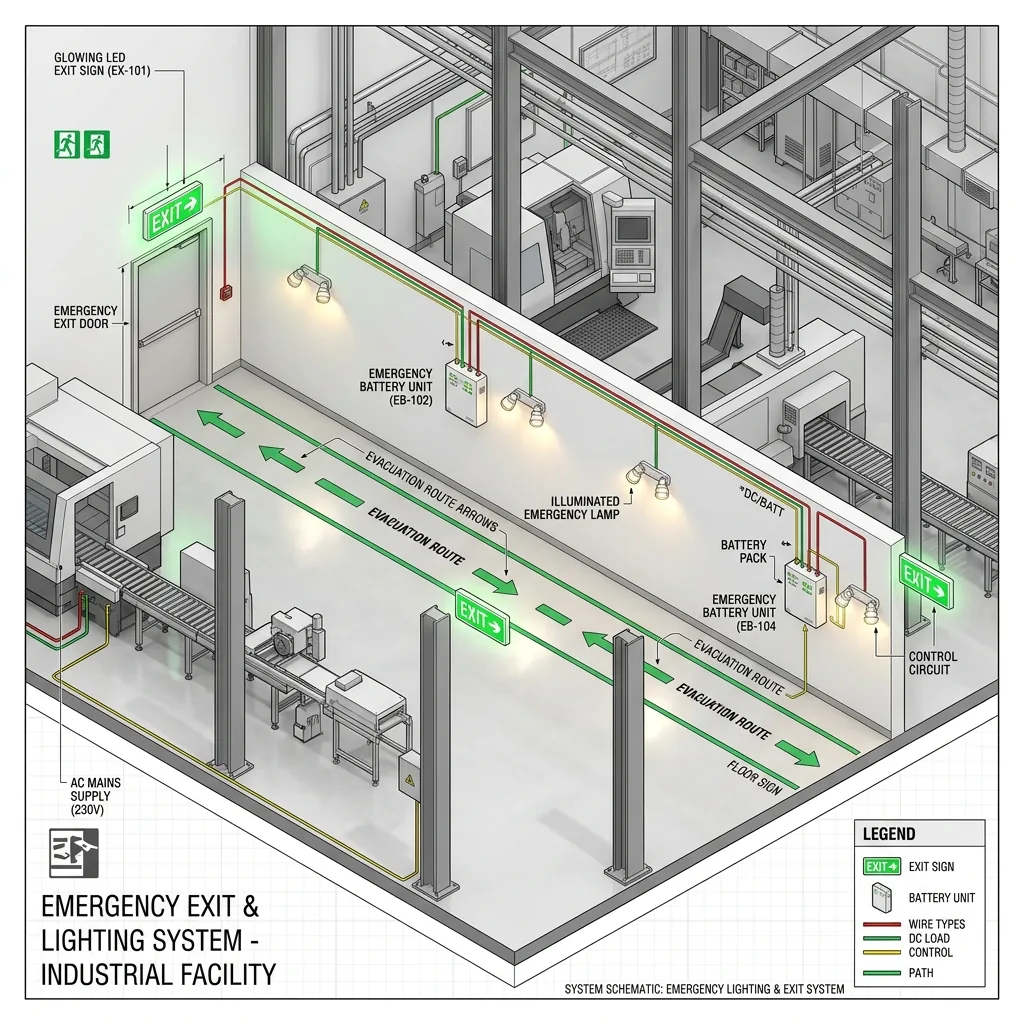
Key Takeaway: While the US uses red "EXIT" signs, many countries around the world mandate "Green Exit Signs" due to human biology—our eyes are most sensitive to green light in dark, smoky conditions. Discover the engineering standards for viewing distances and the life-saving potential of Low-Level Exit Signs.
1. Why Not Red? The Color Psychology Mystery
If you think of Hollywood movies, emergency exits are typically marked with a glowing red "EXIT" sign. In the United States, red is associated with "emergencies" and "fire-fighting equipment." However, in universal color psychology, red universally means "Danger / Stop / Do Not Enter" (like a red traffic light).
In contrast, "Green" is instantly interpreted by the human brain as "Safe / Go / Clear Path". During a fire, when panic levels peak, seeing a green light subconsciously reduces anxiety and guides evacuees toward safety with a clearer mind.
2. The Biology of the Eye: Green Pierces Through Smoke
Beyond psychology, there is a solid physical and biological explanation:
- Photoreceptors (Cone Cells): In low-light conditions (mesopic vision), the cone cells in the human eye are most sensitive to the wavelength of green light (around 500-550 nanometers). This makes green signs appear much brighter and more eye-catching in the dark than other colors.
- Smoke Penetration: When a fire breaks out, corridors fill with thick, black smoke. The specific wavelength and intensity of green light can penetrate smoke particles and reach the retina much better than red light.
3. The "Running Man" Symbol: A Universal Language
In addition to the green color, the international standard ISO 7010 mandates the use of the "Running Man" symbol (designed by Yukio Ota in 1979) instead of just the word "EXIT".
The reason is simple: breaking language barriers. Regardless of age, nationality, or language proficiency, the human brain processes visual symbols exponentially faster than reading text during an emergency.
4. Viewing Distance Standards (EIT & NFPA 101)
Engineering standards define strict rules for the brightness and size of exit signs to ensure they are visible from afar. In Thailand, the Engineering Institute of Thailand (EIT) sets the standard:
Max Viewing Distance (m) = 200 x Height of Symbol (m)
Example: If the running man symbol is 15 centimeters (0.15 m) tall:
Max Viewing Distance = 200 x 0.15 = 30 meters
This means if a corridor exceeds 30 meters, engineers must install additional exit signs along the path to eliminate blind spots.
5. The Secret that Saves Lives: Low-Level Exit Signs
Normally, exit signs are hung from the ceiling or above doors (High-Level). However, in a real fire, hot smoke always rises, quickly accumulating at the ceiling and completely obscuring high-level signs within minutes.
Survivors of smoke inhalation typically escape by crawling low to the ground, where breathable air remains within 1 foot of the floor. For this reason, advanced standards like NFPA 101 recommend Low-Level Exit Signs—glowing strips or signs installed just 30-50 cm above the floor.
When evacuees crawl, they can easily spot these low-level green signs at eye level and follow them to safety. This "secret installation spot" has saved countless lives internationally.
6. Conclusion: Choosing Standard-Compliant Exit Signs
An exit sign is not just a "green light box" for passing building inspections; it is the ultimate piece of Life Safety equipment that guides you away from danger. It is crucial that these signs feature a reliable backup battery system capable of illuminating for at least 2 hours and an Automatic Testing System (ATS).
New Type Engineering Co., Ltd. supplies and installs fully compliant Emergency Lights and Exit Signs (top brands like MAX BRIGHT, SUNNY) meeting TIS (มอก.) and EIT standards.
💬 Consult New Type Safety Engineers
Let our engineers calculate viewing distances and assess installation spots for free!