
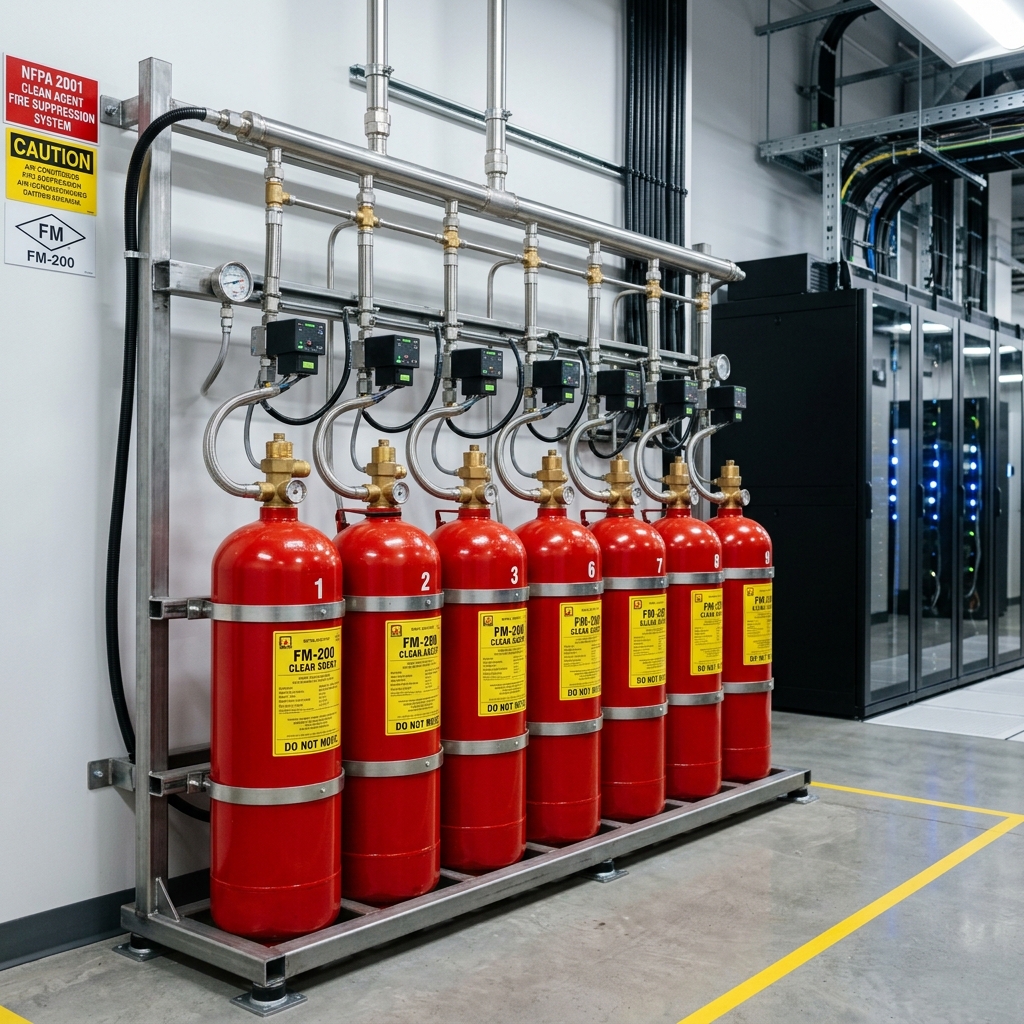
Imagine a minor electrical arcing incident inside a high-density server rack. If traditional water sprinklers discharge, the fire might be extinguished, but millions of dollars in enterprise servers, switchgear, storage arrays, and mission-critical ERP databases are permanently ruined. In critical electronic environments, water damage is far more catastrophic than localized thermal damage. This is why mission-critical facilities worldwide install Clean Agent Fire Suppression Systems under NFPA 2001 (Standard on Clean Agent Fire Extinguishing Systems).
1. Why Water Cannot Be Used for Critical IT & Electrical Rooms
- Conductive Damage & Short Circuits: Water contains dissolved minerals making it electrically conductive, causing instant short-circuit destruction of energized switchgear and PCB traces.
- Corrosive Residue & Thermal Shock: Cold water spraying hot microprocessors causes thermal stress fractures. Moreover, post-fire water residue causes long-term metallic corrosion.
- Zero Downtime Requirement: Clean agents vaporize completely without leaving oily or particulate residue, allowing IT hardware to resume operation immediately after ventilation.
2. Technical Comparison of Gaseous Clean Agents
| Parameter | FK-5-1-12 (Novec 1230) | FM-200 (HFC-227ea) | Inert Gas IG-100 (100% N2) |
|---|---|---|---|
| Primary Mechanism | Heat absorption / Rapid cooling | Heat absorption & chemical reaction | Oxygen reduction (to 12-14%) |
| Environmental Profile | GWP < 1, ODP = 0 (Eco Legend) | GWP = 3,220 (Phased down) | GWP = 0, ODP = 0 (Natural gas) |
| Discharge Speed | 10 seconds max | 10 seconds max | 60 seconds max |
| Storage Footprint | Compact liquid storage cylinder | Compact liquid storage cylinder | High-pressure gas cylinders (200/300 bar) |
3. Detection Logic & System Architecture Under NFPA 2001
Clean agent systems utilize Cross-Zoning (Double Knock) Detection Logic to prevent accidental gas discharges:
- Zone 1 Alarm (First Smoke Detector): Triggers local buzzer and notifies FACP. HVAC dampers remain normal; gas does NOT release.
- Zone 2 Alarm (Second Smoke Detector in Cross Zone): Confirms active fire. Triggers evacuation horns/strobes, shuts down HVAC dampers, and initiates a 30-second countdown.
- Gas Release: Solenoid actuates cylinder valves, discharging clean agent across high-velocity nozzles within 10 seconds.
4. Room Integrity Door Fan Testing Requirements
NFPA 2001 Section 8.4 requires enclosure integrity verification. If the room has unsealed cable penetrations or door gaps, the gaseous agent will drain out rapidly before extinguishing deep-seated fires.
Hold Time Rule: A certified Door Fan Test must prove that the room enclosure maintains agent concentration at 15% height above floor level for at least 10 minutes.
💬 Consult New Type Engineering Team
Get free engineering consultation, NFPA standards advice, and book an on-site survey!
Comprehensive Turnkey Engineering Services
New Type Engineering Co., Ltd. (ISO 9001:2015 Certified, 5M THB Registered Capital) offers expert engineering design, installation, and inspection with free preliminary estimates.