
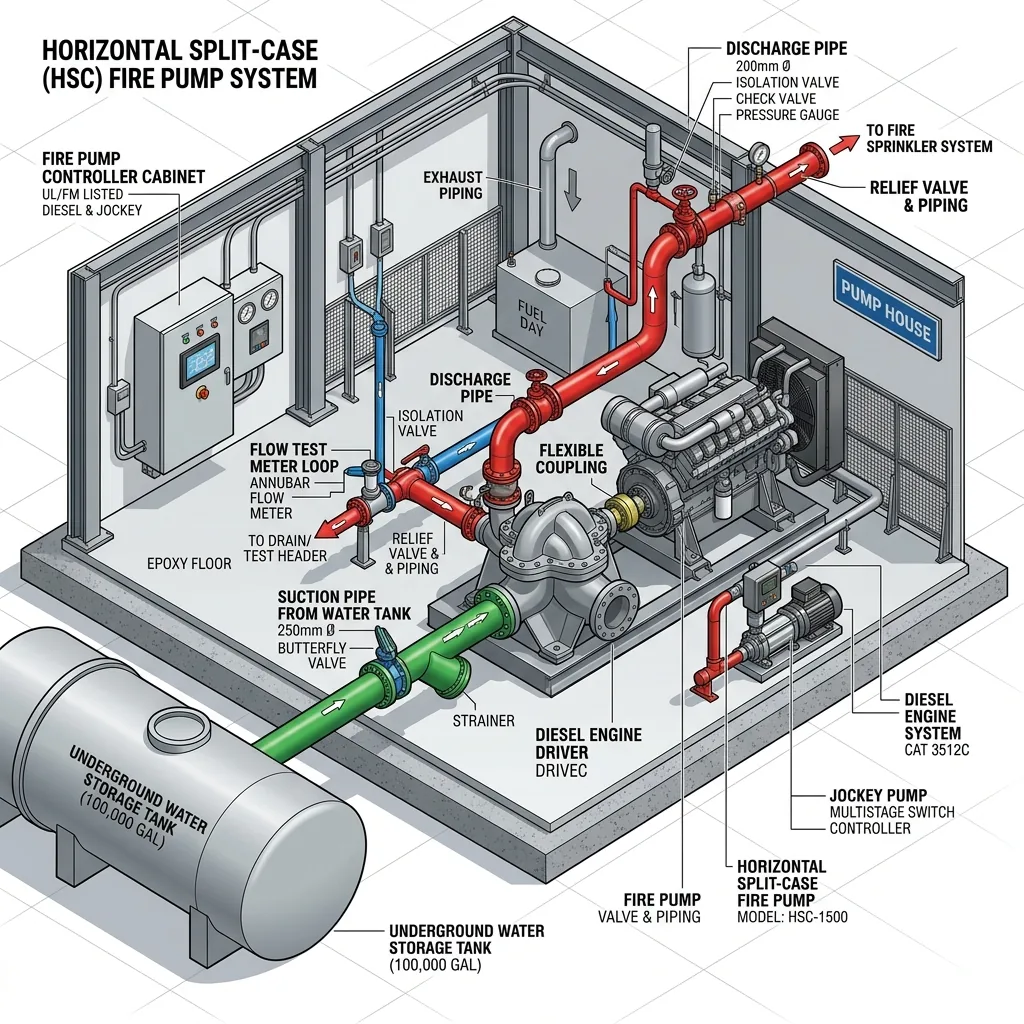
Schematic Diagram: Component Arrangement and Piping Connections inside a Horizontal Split-Case Fire Pump Room
In the fire protection engineering of high-rise commercial buildings and industrial facilities, the Fire Pump System acts as the central heart of life safety. Its sole function is to instantly deliver water at mandatory flow rates and static pressures to automatic fire sprinklers, standpipe hose stations, and deluge systems during a critical emergency. Selecting a fire pump involves far more than matching motor horsepower; it requires strict adherence to international standards under NFPA 20 (Standard for the Installation of Stationary Pumps for Fire Protection) and local building codes.
This technical guide delves into the structural pump types, suction hydraulic boundaries, performance curve mathematics, and driver selection criteria that design engineers and facility executives must know.
1. Fire Pump Types Recognized Under NFPA 20
NFPA 20 permits centrifugal fire pumps for fire protection applications, categorizing them into four distinct structural architectures, each serving specific hydraulic and spatial requirements:
1.1 Horizontal Split-Case (HSC) Centrifugal Pump
The Horizontal Split-Case pump is the most widely specified configuration for medium-to-large industrial plants and commercial high-rises. Its casing is split horizontally across the shaft centerline, allowing complete internal inspection without disturbing suction/discharge piping or motor alignment.
- Engineering Superiority: HSC pumps utilize double-suction impellers that balance hydraulic thrust forces, resulting in smooth operation, low bearing wear, and extreme mechanical longevity. Capacities range from 150 GPM to over 5,000 GPM at elevated heads.
- Maintenance Advantage: Unbolting the top casing cover grants direct access to the shaft, impellers, and wear rings without disconnecting piping or unmounting the driver.
- Boundary Constraint: Requires a larger mechanical room footprint and strictly demands positive flooded suction.
1.2 End Suction Centrifugal Pump
End Suction pumps feature an axial suction inlet at the front and a vertical discharge outlet at 90 degrees on top.
- Engineering Advantage: Compact physical footprint and economical procurement cost. Ideal for smaller commercial facilities, light hazard warehouses, and mechanical retrofits (typically under 750-1,500 GPM).
- Boundary Constraint: Single-suction impellers impose higher axial loads on bearings. Major maintenance requires unbolting suction piping or moving the driver.
1.3 Vertical Inline Centrifugal Pump
Vertical Inline pumps have suction and discharge flanges arranged along the same horizontal plane, mounting directly into the pipeline akin to a valve.
- Engineering Advantage: Zero floor footprint requirement. Factory-aligned vertical shaft eliminates field shaft alignment tasks. Perfect for space-constrained urban high-rises.
- Boundary Constraint: Limited capacity ratings (typically max 1,500 GPM). Servicing motor bearings requires vertical crane lifting of the heavy top-mounted motor assembly.
1.4 Vertical Turbine Pump
Vertical Turbine pumps feature a surface-mounted driver and head assembly, while the multi-stage bowl and impeller assembly extends downward into a submerged water pit or underground tank.
- Engineering Advantage: The ONLY pump type permitted by NFPA 20 for negative suction head / suction lift applications (e.g., underground water reservoirs, natural ponds, or rivers). Submerged impellers eliminate priming failure risks completely.
- Boundary Constraint: Higher capital cost, complex vertical shaft thrust balancing, and requiring overhead crane lifting for sub-surface inspection.
2. Suction Configuration & Mandatory Flooded Suction Rules
The single most frequent engineering violation found during industrial facility audits is using horizontal pumps to draw water from below-grade tanks via suction lift.
NFPA 20 Mandatory Rule: Horizontal centrifugal pumps (HSC, End Suction, Inline) MUST operate under continuous Flooded Suction. The lowest acceptable water level in the fire water storage tank must remain above the centerline of the pump suction pipe at all times.
2.1 Why Suction Lift is Prohibited for Horizontal Pumps
- Loss of Prime Risk: Horizontal pumps cannot self-prime. A minor leak in foot valves or suction gaskets entraps air, causing the pump to run dry during an automated fire emergency.
- Destructive Cavitation: Negative suction pressures cause localized water vapor flashing. Collapsing vapor bubbles erode impellers and collapse output pressure catastrophically.
- Automatic Start Reliability: Weekly NFPA 25 churn tests can cause dry-running motor burnouts if priming is lost.
3. Pump Performance Curves & NFPA 20 Hydraulic Criteria
Every UL-listed / FM-approved fire pump must strictly comply with the three-point hydraulic performance envelope specified in NFPA 20 Section 6.2:
| Operating Condition | Flow Rate (% Rated Flow) | Net Head Pressure Requirement (% Rated Head) |
|---|---|---|
| Shutoff / Churn Pressure | 0% Flow | Shall NOT exceed 140% of rated pressure (Max 140%) |
| Rated Operating Point | 100% Flow | 100% of rated net head pressure |
| Peak Flow Capacity | 150% Flow | Shall NOT fall below 65% of rated head pressure |
H_150% >= 0.65 * H_rated
4. Driver Selection: Electric Motors vs. Diesel Engines
NFPA 20 permits two reliable power sources for driving fire pumps:
- Electric Motor Drivers: Clean, quiet, and reliable. Must be served by a reliable dedicated utility feed or backed by an Automatic Transfer Switch (ATS) linked to an emergency generator under NFPA 110.
- Diesel Engine Drivers: Self-contained independent drivers ideal for facilities with vulnerable electrical grids. Require dedicated dual battery sets, jacket water heaters, and a dedicated fuel tank with capacity for at least 8 hours of full-load operation (1 gal per HP + 5% expansion volume).
5. Engineering Recommendations for Retrofitting Non-Compliant Systems
If an existing plant currently operates a horizontal pump drawing from a below-ground tank, NTE recommends two corrective options:
- Replace the horizontal pump with a UL/FM listed Vertical Turbine Fire Pump.
- Construct an above-ground bolted steel fire water tank providing positive flooded suction.
💬 Consult New Type Engineering Team
Get free engineering consultation, NFPA standards advice, and book an on-site survey!
Comprehensive Turnkey Engineering Services
New Type Engineering Co., Ltd. (ISO 9001:2015 Certified, 5M THB Registered Capital) offers expert engineering design, installation, and inspection with free preliminary estimates.