
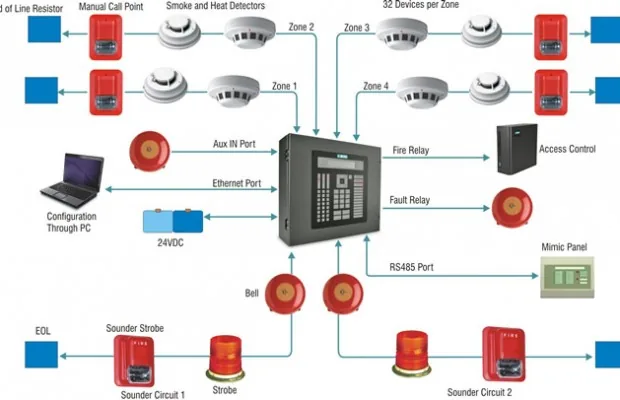
An early fire detection and alarm system serves as the primary intelligence network for industrial plants and commercial high-rises. Governed by NFPA 72 (National Fire Alarm and Signaling Code), a properly designed fire alarm installation senses smoldering thermal events long before visible flames erupt, initiating automated evacuation and suppressing catastrophic property losses.
1. Addressable vs. Conventional Systems
| Feature | Conventional Fire Alarm System | Intelligent Addressable System (Siemens Cerberus PRO) |
|---|---|---|
| Location Pinpointing | Zone level only (e.g., "Zone 3 - Floor 2") | Exact device address (e.g., "Detector 42 - Server Room Rack 5") |
| Wiring Architecture | Radial multi-wire per zone | SLC Loop circuit with Isolator Modules |
| False Alarm Sensitivity | Fixed threshold | Drift compensation & ASA multi-criteria AI sensing |
2. Key NFPA 72 Detector Spacing Guidelines
- Optical Smoke Detectors: 9.0 meters (30 ft) maximum spacing on smooth ceilings. Reduce spacing in high-airflow environments.
- Heat Detectors: 15.0 meters (50 ft) maximum spacing. Installed within 0.7m of roof peaks.
- Manual Pull Stations: Mounted at 1.1m to 1.37m height, placed within 1.5m of every emergency exit door.
3. Notification Appliance Sound Requirements
NFPA 72 requires audible evacuation horns to produce sound pressure levels at least 15 dBA above average ambient noise levels or 5 dBA above maximum ambient noise levels lasting more than 60 seconds.
💬 Consult New Type Engineering Team
Get free engineering consultation, NFPA standards advice, and book an on-site survey!
Comprehensive Turnkey Engineering Services
New Type Engineering Co., Ltd. (ISO 9001:2015 Certified, 5M THB Registered Capital) offers expert engineering design, installation, and inspection with free preliminary estimates.